

If you have ever seen a photo or video showing two different-colored bodies of water meeting without mixing, you may have wondered: why don’t the Atlantic and Pacific Oceans mix? The images can make it look as if an invisible wall separates the two oceans. But the real answer is much more interesting. The Atlantic and Pacific Oceans do mix. There is no permanent barrier stopping their waters from blending. However, ocean water does not mix instantly. Differences in salinity, temperature, density, currents, and water movement can cause different water masses to remain visibly separate for some time. So, what is really happening when we see those dramatic lines between two colors of water? Let’s look at the science in simple words.
Table of Contents
The Viral Video Everyone’s Talking About
Videos showing two different-colored waters meeting have become extremely popular online. They are often presented as proof that the Atlantic and Pacific Oceans meet but somehow refuse to mix. The sharp line between the waters certainly looks strange. One side may appear dark blue while the other looks lighter, greener, or even gray. It is easy to assume that these are two oceans standing side by side.
In many cases, the water in these viral images is not an Atlantic-Pacific boundary at all. The different colors can come from sediment, glacial meltwater, freshwater from rivers, plankton, or differences in salinity and temperature. When these waters reach the ocean, they can form visible boundaries and swirling patterns.
The misunderstanding partly comes from the fact that the Atlantic and Pacific really are connected. They meet through several routes, especially around the southern tip of South America and through the Southern Ocean. But there is no permanent line where the Atlantic suddenly stops and the Pacific begins. Ocean water is constantly moving across these regions.
So, Why Don’t the Atlantic and Pacific Oceans Mix?
They do mix, but the process is not immediate. Think about pouring two liquids with slightly different properties into the same container. They may begin mixing at the contact point, but it can take time before they become evenly blended. The ocean is much more complicated, but the basic idea is similar. Three factors are especially important: salinity, temperature, and density.
Salinity Affects Water Density
Salinity means the amount of dissolved salt in water. Saltier water is generally denser and heavier than less salty water. When two water masses have different salinity levels, they may not immediately blend into one uniform layer. The Pacific, for example, is generally less salty than the Atlantic. Differences in rainfall, evaporation, river runoff, and other processes help create these variations.
Temperature Also Matters
Temperature changes the density of seawater too. Cold water is generally denser than warm water. This means cold water tends to sink below warmer water when conditions allow it. When water masses with different temperatures meet, they can initially remain layered or form a visible boundary.
Density Controls Much of the Deep Ocean
Salinity and temperature work together to determine seawater density. When seawater becomes cold and salty enough, it can sink into the deep ocean. Warmer or less salty water is more likely to remain closer to the surface. This movement is an important part of the ocean’s large-scale circulation. However, density does not mean the waters are permanently separated. Waves, tides, storms, currents, and turbulence constantly push water masses together and encourage mixing.
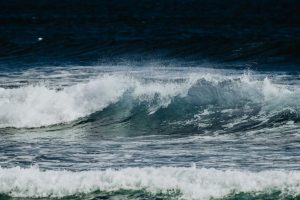
The Real Story Behind Those Viral Photos
One of the best examples of a misleading ocean photo can be found in the Gulf of Alaska.
Glacial Water Can Create a Dramatic Color Difference
Mountain glaciers grind rocks underneath them into extremely fine particles. These tiny particles, often called glacial flour, can be carried into the ocean by rivers. When the sediment-rich freshwater reaches the sea, it can create a striking turquoise or milky color. That water can sit next to darker ocean water, creating the appearance of a sharp boundary.
The Copper River Example
The Copper River, immediately east of Prince William Sound, carries large amounts of glacial sediment into the Gulf of Alaska. NASA satellite images have captured beautiful turquoise swirls in this region. The unusual color is largely caused by sediment from glaciers, although biological activity such as phytoplankton can also affect ocean color. The important point is that a visible color difference does not mean two oceans are refusing to mix. The water is moving, spreading, and mixing. The colors simply make the process easier for our eyes to notice.
Where Do the Atlantic and Pacific Oceans Actually Meet?
There isn’t one exact place where you can point to a line and say, “This is where the Atlantic ends and the Pacific begins.” Instead, the two ocean systems are connected through several important waterways.
Drake Passage
One major connection is the Drake Passage, between the southern tip of South America and Antarctica. It connects the Atlantic and Pacific and is famous for its powerful winds, waves, and currents. These rough conditions create plenty of turbulence, which helps water from different regions mix.
Strait of Magellan and Beagle Channel
Around southern South America, the Strait of Magellan and Beagle Channel also provide connections between Pacific- and Atlantic-influenced waters. These areas can sometimes show visible boundaries because of differences in freshwater, sediment, temperature, or salinity. But these are temporary water fronts, not permanent walls.
How Ocean Mixing Really Works
Ocean mixing happens on many different scales. At the surface, wind is one of the biggest drivers. Waves and storms stir the upper ocean and push water masses together. Below the surface, density differences become particularly important.
Thermohaline Circulation
You may come across the term thermohaline circulation when reading about ocean mixing. “Thermo” refers to temperature, while “haline” refers to salinity. Together, they describe circulation caused by differences in seawater density. Cold, salty water can become heavy enough to sink, while warmer or less dense water remains closer to the surface. This creates large movements of water through the deep ocean.
The Global Ocean Conveyor Belt
Scientists often describe this huge circulation system as the global ocean conveyor belt. It combines deep-ocean circulation with wind-driven surface currents and helps move heat, oxygen, nutrients, and other properties around the planet. This process is extremely slow compared with the movement of waves or surface currents. Some parts of deep-ocean circulation operate over centuries or longer. That is one reason the ocean cannot simply become completely uniform overnight.
Do the Atlantic and Pacific Ever Fully Mix?
They constantly exchange water, but “fully mix” is not really a simple yes-or-no process. Different water masses can keep some of their original characteristics for long periods while gradually mixing with surrounding water. A major player is the Antarctic Circumpolar Current, which flows around Antarctica and connects the Atlantic, Pacific, and Indian Ocean systems.
Scientists can identify the origins of water by studying properties such as temperature, salinity, oxygen, nutrients, and chemical tracers. For example, Pacific-origin water can sometimes be detected in Atlantic-connected waters even after it has traveled a considerable distance. This shows that ocean basins are not isolated containers. They are parts of one connected global ocean system.
What About Climate Change?
Climate change can affect ocean circulation because warming and changes in freshwater input can alter seawater density. For example, additional freshwater from melting ice can make some areas of the ocean less salty and therefore less dense. Changes in temperature and salinity can influence large-scale circulation, including important Atlantic circulation systems. Scientists continue to study how these changes could affect ocean circulation and climate.
Common Myths About Ocean Boundaries
Myth 1: The Atlantic and Pacific Never Mix
False. They absolutely mix. Their waters are constantly moving and exchanging through currents and connected seas. The process simply happens at different speeds in different places.
Myth 2: There Is a Permanent Visible Line Between Them
There is no permanent wall or perfectly straight line separating the Atlantic and Pacific. Visible lines are usually ocean fronts, where water with different properties meets. These boundaries can move, weaken, and disappear.
Myth 3: The Waters Behave Like Oil and Water
Some viral posts make the oceans look like two liquids that naturally repel each other. That is not what happens. Ocean water is continuously stirred by wind, waves, tides, currents, storms, and turbulence. Differences in density can slow mixing in certain situations, but they do not stop it permanently.
Myth 4: The Gulf of Mexico Shows the Atlantic-Pacific Boundary
The Gulf of Mexico is part of the Atlantic Ocean system, so colorful water there should not be interpreted as an Atlantic-Pacific boundary. Different water colors in coastal areas are often caused by sediment, freshwater, plankton, or other local conditions.
Why Does Ocean Mixing Matter?
Ocean mixing is much more than an interesting visual phenomenon.
It Supports Marine Life
Mixing helps move nutrients and oxygen through the ocean. Nutrients brought toward the surface can support phytoplankton, which form the base of many marine food webs. Currents also transport heat and help distribute organisms and nutrients between different regions.
It Influences Climate
The ocean stores and moves enormous amounts of heat. Large-scale circulation helps redistribute that heat around the planet, influencing weather patterns, marine ecosystems, and regional climate. This is why scientists pay close attention to changes in ocean currents and circulation.
Wrapping Up
So, why don’t the Atlantic and Pacific Oceans mix? The truth is that they do. The viral images simply make a temporary difference between water masses look like a permanent boundary. Differences in salinity, temperature, density, sediment, and currents can keep water looking separate for a while, but wind, waves, tides, and deep-ocean circulation continue to move and mix it. The Atlantic and Pacific are not two isolated oceans refusing to touch. They are connected parts of one enormous global ocean system, constantly exchanging water, heat, nutrients, and energy.
FAQs
Q1. Do the Atlantic and Pacific Oceans actually mix?
Yes. The Atlantic and Pacific are connected, and their waters constantly exchange and mix. The process can be slow in some places because of differences in temperature, salinity, and density.
Q2. Why do the two oceans sometimes look like they don’t mix?
Different water masses can have different colors, temperatures, salinity levels, and sediment concentrations. When they meet, these differences can create a visible boundary that may remain noticeable for a while.
Q3. Where do the Atlantic and Pacific Oceans meet?
There is no single meeting line. Important connections include the Drake Passage, Strait of Magellan, and Beagle Channel, along with the broader connection created by the Southern Ocean.
Q4. Why is the Gulf of Alaska famous for different-colored water?
Glaciers in Alaska grind rocks into extremely fine sediment. Rivers such as the Copper River carry this sediment into the Gulf of Alaska, creating striking turquoise and blue-green water patterns.
Q5. How long does it take for ocean water to mix?
There is no single mixing time. Surface water can mix relatively quickly, while deep-ocean circulation can take centuries or longer. Wind, tides, currents, storms, temperature, salinity, and underwater geography all affect the process.

