

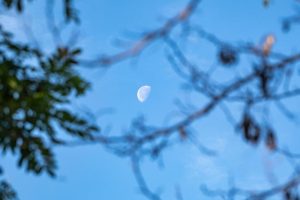
Look up on a clear afternoon and you may notice the Moon sitting quietly in the blue sky. It can seem strange because we usually associate the Moon with nighttime. So, why can we see the moon during the day?
The simple answer is that the Moon is not limited to the night sky. It can be above your horizon while the Sun is still out, and its surface reflects sunlight toward Earth. Daylight makes the Moon harder to notice than it is at night, but it can still stand out clearly under the right conditions.
The timing depends mainly on the Moon’s phase, its position in the sky, and where you are on Earth.
Table of Contents
Why Can We See the Moon During the Day?
The Moon does not produce its own light. What we call moonlight is sunlight reflected from its surface. Half of the Moon is always illuminated by the Sun, except during a lunar eclipse. As the Moon travels around Earth, you see different portions of that sunlit half. This changing view creates the familiar Moon phases.
So, when you see the Moon during an afternoon, it is not producing daylight or doing anything unusual. It simply happens to be above your horizon at the same time as the Sun. Several factors determine whether you can spot it:
- Moon phase: Different phases appear at different times of day.
- Position above the horizon: The Moon must be above your local horizon.
- Sky conditions: Clouds, haze and pollution can make it difficult to see.
- Daylight: A bright sky can hide a thin crescent or faint-looking Moon.
Why Is the Moon Visible When the Sky Is Bright?
The daytime sky is bright because sunlight is scattered through Earth’s atmosphere. That brightness makes faint objects, especially most stars, difficult to see.
The Moon is much closer to Earth and reflects enough sunlight to remain visible against the blue sky. This is why a daytime Moon can be easy to spot even though most stars disappear from view. You may notice the Moon more easily when it is far from the Sun in the sky and when the surrounding sky is clear.
Why Can You See the Moon but Not Most Stars During the Day?
Stars are extremely bright objects, but they are so far away that their light appears faint from Earth. During the day, scattered sunlight makes the sky bright enough to overwhelm most starlight. The Moon has a major advantage: distance. It is Earth’s closest natural satellite, so reflected sunlight makes it much easier to see.
That is why why can we see the moon during the day has a very different answer from why you cannot normally see stars at the same time. The Moon is simply much brighter in our sky.
Can You See the Moon Every Day?
The Moon can be above the horizon during daylight on many days, but that does not mean you will see it every day. Its position changes as it orbits Earth, and its phase changes throughout its roughly 29.5-day cycle. Some phases are well placed for daytime viewing, while others are mainly visible at night.
Your location matters too. The Moon can be above the horizon for one observer while being below it for another.
How Moon Phases Affect Daytime Visibility
The Moon’s phase has a major effect on when you can see it. As the Moon orbits Earth, the angle between the Sun, Earth and Moon changes. From Earth, this makes the illuminated portion appear to grow and shrink.
| Moon phase | Approximate daytime visibility |
| New Moon | Usually not visible |
| Waxing Crescent | Morning to afternoon |
| First Quarter | Around midday into the afternoon |
| Waxing Gibbous | Afternoon toward evening |
| Full Moon | Usually associated with nighttime |
| Waning Gibbous | Morning |
| Third Quarter | Morning to midday |
| Waning Crescent | Morning to afternoon |
These are general patterns rather than fixed viewing times. The exact timing changes with your location and the date.
New Moon
A new Moon is generally not visible even though it can be above the horizon during the day. At this point, the side facing Earth is mostly unlit, while the illuminated side faces the Sun. The Moon is also close to the Sun in the sky, making it especially difficult to see.
Waxing Crescent
A waxing crescent can appear in the daytime sky, particularly later in the morning or afternoon. Only a small part of the Moon’s sunlit side faces Earth, so the thin crescent may look faint against the bright sky.
First Quarter
The first quarter Moon is one of the easiest phases to spot during daylight.
It is generally above the horizon from around midday into the evening. About half of the visible lunar disk is illuminated, giving you a clearly defined shape.
Waxing Gibbous
A waxing gibbous Moon can be visible during the afternoon before becoming more prominent after sunset. More of its sunlit side faces Earth at this stage, so it generally appears brighter than a crescent Moon.
Full Moon
A full Moon is usually associated with nighttime because it is positioned opposite the Sun from Earth’s perspective. It generally becomes visible around sunset and remains in the sky through the night. A nearly full Moon can sometimes remain visible around the edges of daylight.
Waning Gibbous
A waning gibbous Moon is commonly visible during the morning. It can remain above the horizon after the Sun has appeared, giving you the chance to spot a large, bright Moon in the western part of the sky.
Third Quarter
The third quarter Moon is another good example of daytime visibility. It generally appears during the morning and can remain above the horizon until around midday.
Waning Crescent
A thin waning crescent can appear during the morning and early afternoon.
Because only a small portion of its sunlit side is visible from Earth, it can be harder to notice against a bright sky.
What Time Can You See the Moon During the Day?
There is no single time when the Moon is visible during daylight. Its viewing time changes with its phase. For example, a first-quarter Moon is generally visible around midday and into the afternoon. A waning gibbous Moon is more likely to be seen in the morning, while a waxing gibbous Moon can appear during the afternoon.
The Moon also appears in a slightly different position from one day to the next because it is moving along its orbit.

Why Can’t You Always See the Moon During the Day?
Even when the Moon is above your horizon, several things can prevent you from seeing it.
1. It may be below your horizon: The Moon is not above the horizon everywhere at the same time. If it is on the other side of Earth relative to your location, you will not be able to see it.
2. The sky may be too bright: A thin crescent can be difficult to distinguish from a bright blue sky.
3. Clouds or haze may block it: Clouds, atmospheric haze and pollution can make the daytime Moon much harder to spot.
4. It may be close to the Sun: Some phases place the Moon close to the Sun in the sky. This makes it difficult to see and means you should never look directly toward the Sun while searching for the Moon.
Why Does the Moon Look Fainter During the Day?
The Moon itself has not suddenly become less bright. The difference mainly comes from contrast. Against a dark night sky, the illuminated Moon stands out strongly. During the day, the surrounding sky is already filled with scattered sunlight, so the Moon can appear less striking.
Your eyes also adjust to the overall brightness around you, which can change how the Moon’s brightness and color appear.
Does the Moon Produce Its Own Light?
No. The Moon does not make its own visible light.
It reflects sunlight from its surface. As the Moon moves around Earth, you see different amounts of that illuminated surface, creating the phases.
There is also a phenomenon called earthshine. Sunlight can reflect from Earth onto the Moon and then back toward us, making the darker portion of a young crescent sometimes faintly visible.
How to Spot the Moon During the Day
Finding a daytime Moon becomes much easier when you know roughly where to look.
- Check the Moon phase. First-quarter and gibbous phases are often easier to notice than a very thin crescent.
- Choose a clear day. Clouds and haze can hide the Moon even when it is in the right position.
- Look away from the Sun. Never stare at the Sun while trying to locate the Moon.
- Look higher in the sky. The Moon may be easier to spot when it is well above buildings, trees and the hazy area near the horizon.
- Check at different times. The Moon’s position changes throughout the day, so you may miss it at one time and spot it a few hours later.
Common Myths About the Daytime Moon
1. “The Moon only comes out at night.”
False. The Moon can be above the horizon during both daytime and nighttime.
2. “A daytime Moon means something unusual is happening.”
No. Seeing the Moon in daylight is a normal part of its monthly cycle.
3. “Earth’s shadow creates the Moon’s phases.”
No. Normal phases happen because we see different portions of the Moon’s sunlit half as it orbits Earth. Earth’s shadow is involved only during a lunar eclipse.
4. “The Moon makes its own light.”
It does not. The Moon is visible because it reflects sunlight.
Wrapping Up
So, why can we see the moon during the day? The Moon reflects sunlight, and its orbit regularly places it above your horizon while the Sun is still in the sky.
Its phase affects how much of the illuminated surface you see, while Earth’s rotation makes the Moon appear to move across your sky. Once you understand these simple pieces, spotting a Moon in the middle of the afternoon makes perfect sense.
Frequently Asked Questions (FAQs)
Q1. Can you see the Moon during the day?
Yes. The Moon can be visible during daylight when it is above your horizon and its phase and position make it easy enough to spot.
Q2. Why is the Moon sometimes visible in the afternoon?
The Moon orbits Earth, so it is not tied to nighttime. Depending on its phase, it can remain above your horizon well into the afternoon.
Q3. What Moon phase is easiest to see during the day?
The first-quarter and gibbous phases are generally easier to notice because a substantial portion of the Moon’s visible surface is illuminated.
Q4. Why can’t you see the Moon every day?
The Moon may be below your horizon, hidden by clouds or haze, too close to the Sun, or too faint against the daytime sky. A new Moon is also normally invisible because the illuminated side faces away from Earth.
Q5. Is seeing the Moon during the day rare?
No. Daytime Moon visibility is completely normal. The Moon is above the horizon during daylight for a substantial amount of time, although whether you actually notice it depends on its phase, position and sky conditions.

